
sight glass
What is the working principle of sight glass?
มี.ค.
What is the working principle of sight glass?
What is the working principle of sight glass?. Working Principle of Sight Glass
A sight glass, also known as a sight gauge or level gauge, is a transparent tube or window used in industrial processes to visually monitor and determine the level of liquids, and sometimes, the flow of gases or the presence of particulates in certain systems. Its operation is straightforward, relying primarily on visual observation. Here’s a breakdown of its working principle:
1. Visual Clarity
A sight glass is typically made of a transparent material, often glass o, that provides a clear visual of the internal contents. This transparency allows operators to observe the level, color, and condition of the fluid inside a vessel or pipeline.
2. Hydrostatic Pressure
In vertically oriented sight glasses, which are commonly used to indicate liquid levels, the principle of hydrostatic pressure is at play. In a closed system:
The liquid inside the sight glass will stabilize at the same level as the liquid in the adjacent vessel or tank.
This is because the pressure at the bottom of both the tank and the sight glass (assuming they are connected) is the same due to the weight of the liquid column above that point.
3. Reflex and Transparent Types
There are two primary types of sight glasses based on their design and working principle:
Reflex Sight Glass: This type uses the principles of light refraction and reflection. The glass is prismatic, with one side having ridges. When there’s no liquid behind this prismatic glass, light reflects off the ridges and makes them appear silver, showing the area as empty. When the section is filled with liquid, light refracts differently, allowing a clear view of the liquid, which contrasts against the silver sections.
Transparent Sight Glass: This is a simpler design with two transparent glasses on either side of the chamber. The user can see directly through the chamber to observe the liquid level. For safety and clarity, these are often equipped with protective shields and may have scales or markings to indicate levels.
4. Observational Accuracy
To enhance the accuracy of observation:
Some sight glasses have scales or markings that allow for a more precise reading of the liquid level.
Additionally, colored or fluorescent fluids can be added to systems to improve visibility against a transparent background.
Conclusion
The sight glass is an invaluable tool in many industrial settings, providing a simple yet effective means to monitor and measure the level and condition of fluids within systems. Its operation is based on basic principles of physics and optics, ensuring reliable performance with minimal complexity.
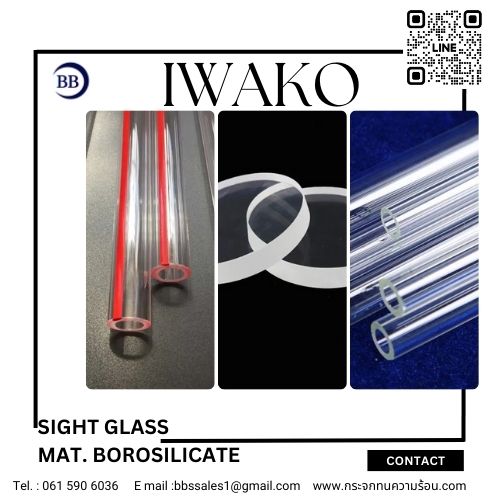
BB Steel Internationnal Supplier product “IWAKO” : Borosilicate Sight Glass ,Disc Sight Glass,Round Sight Glass, Tube Sigh Glass, Water Liquid Level Gauge , Water Level Gauge,Bronze water gauge valve,Gauge Valve with Sight Glass Tube ,Stainless Steel Liquid Level Gauges , Stainless Steel Gauge Cock,Water Gauge ,Gauge Valve with Sight Glass Cock, Oil Level Gauge , Bronze Water Gauges,Brass Oil Level Gauge , Flow Sight Glass.
Line ID : @bbsinter
Tel. 061 – 590 6036