
Anode
Sacrificial Anode in a Heat Exchanger
ก.พ.
Sacrificial Anode in a Heat Exchanger
What is the purpose of the sacrificial anode in a heat exchanger?
The purpose of a sacrificial anode in a heat exchanger is to prevent or significantly reduce the corrosion of the heat exchanger’s metal components. This process is part of a corrosion control technique known as cathodic protection. Here’s how it works:
-Corrosion Prevention:
Heat exchangers often involve metal parts in contact with water or other fluids, which can lead to corrosion. Corrosion is a natural process where metals deteriorate due to chemical reactions with their environment, particularly through oxidation.
-Electrochemical Cell Formation:
When two different metals are in contact with an electrolyte (like water), an electrochemical cell is formed. In this cell, the more reactive metal (having a higher electrochemical potential) becomes the anode, and the less reactive metal becomes the cathode.
-Sacrificial Anode Principle:
A sacrificial anode is made of a metal that is more reactive than the heat exchanger’s material (usually steel). Common materials for sacrificial anodes include magnesium, aluminum, and zinc.
By installing a sacrificial anode, it becomes the anode of the electrochemical cell, while the heat exchanger’s metal becomes the cathode.
The sacrificial anode corrodes instead of the heat exchanger’s metal, hence the term “sacrificial.” This corrosion of the anode protects the more valuable metal components of the heat exchanger.
-Extending Equipment Lifespan:
By diverting corrosion to the sacrificial anode, the structural integrity and lifespan of the heat exchanger are significantly improved. This is particularly important in environments where corrosion is accelerated, such as in the presence of saltwater or certain chemicals.
-Cost-Effective Maintenance:
Replacing sacrificial anodes at regular intervals is a relatively low-cost maintenance strategy compared to the potential cost of repairing or replacing a corroded heat exchanger.
-Improved System Efficiency:
Corrosion can lead to inefficiencies in heat transfer and system operations. By minimizing corrosion, sacrificial anodes help maintain the efficiency of the heat exchanger.
In summary, sacrificial anodes play a vital role in protecting heat exchangers from corrosion, thereby prolonging their service life, maintaining efficiency, and reducing maintenance and replacement costs. Regular inspection and replacement of these anodes are essential to ensure continuous protection.
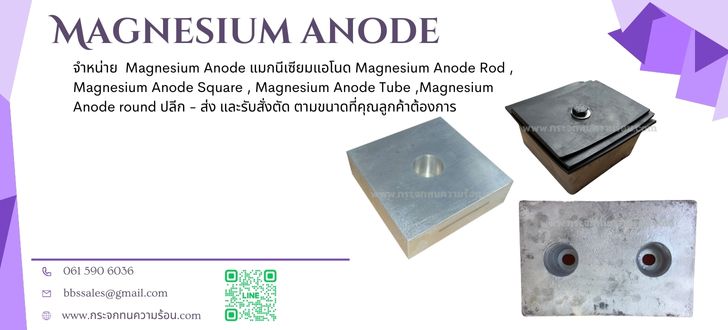
Magnesium anodes for sale Type Magnesium Anode Rod , Magnesium Anode Square , Magnesium Anode Tube ,Magnesium Anode round.
Line ID : @bbsinter
Tel. 061-5906036